


Set Your Pulse: Take a breath. Turn your attention to your body and release any tension. Breathe slowly into the area of your heart for 60 seconds, focusing on feeling a sense of ease. Stay connected to your body as you read. Click here to learn why we suggest this.
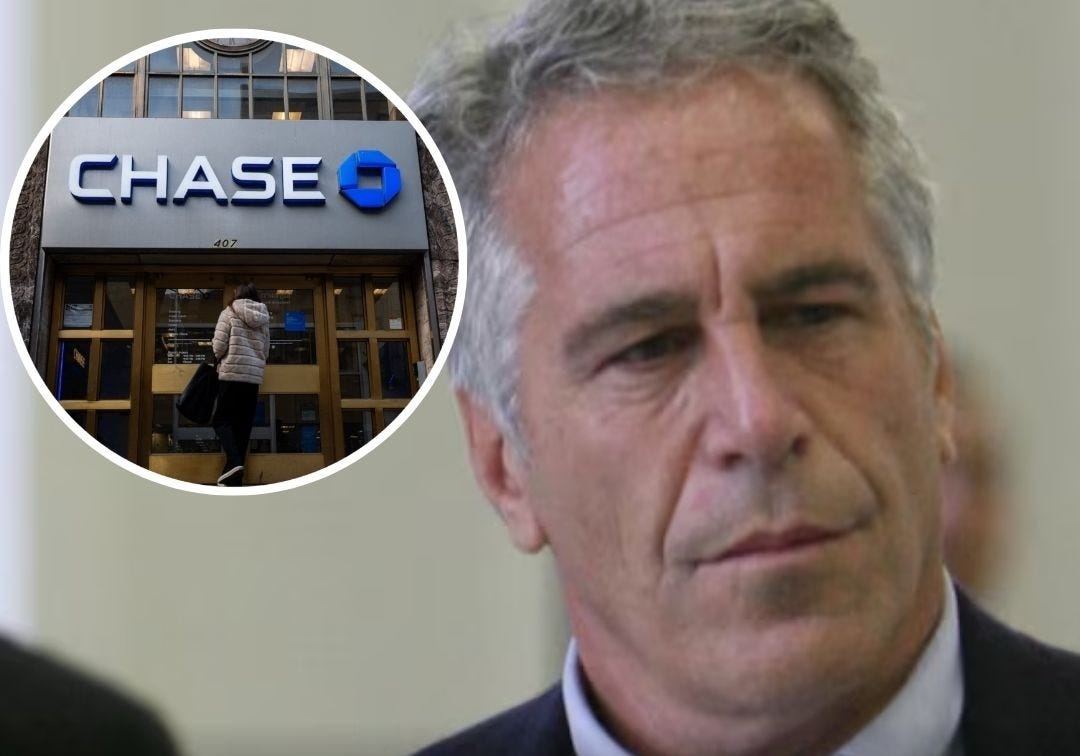
I want to be clear about what JPMorgan’s own internal documents show in this case, because this is not speculation and it is not circumstantial; it is what the bank’s own files recorded and what federal court proceedings have made part of the public record.
55 accounts and over 1.1 billion dollars processed. Payments to more than 20 named victims, most of them children. Over 600,000 dollars processed to a girl that the bank’s own internal files noted Epstein had “purchased” at age 14, and I want you to sit with that word for a moment because the bank wrote it down themselves, in their own building, in their own records, the word “purchased” about a 14 year old girl, as though she were a line item in an inventory system, and then they kept processing his transactions because the money was too good and the girl was too powerless for anyone in that building to find it worth stopping.
A lawyer for the US Virgin Islands did some arithmetic during a court hearing that is genuinely difficult to read without feeling something shift inside you, taking the roughly 9 million dollars in transfers to girls and women from Epstein’s accounts, dividing it by the few hundred dollars he typically paid per encounter, and arriving at a number of over 20,000 facilitated rapes, with her exact words being that JPMorgan was “a full service bank for Jeffrey Epstein’s sex trafficking,” full service, like a car wash, except for the systematic abuse of children.
What’s wild is, JPMorgan’s own compliance department flagged Epstein’s accounts repeatedly, over years, doing exactly the job they were hired to do, identifying the financial backbone of what was clearly a child trafficking operation and reporting it internally, and every single time senior management buried it because the money mattered more than the children.
This is a story about a bank that knew, documented what it knew, joked about what it knew in internal emails, and made a series of deliberate institutional decisions to keep the relationship alive anyway. These facts matter because they changes the nature of what we’re actually talking about from negligence into something considerably darker.
In 2012 a senior executive sent an email to Mary Erdoes, who runs JPMorgan’s Asset and Wealth Management division, joking that a client’s home had “fewer nymphettes” than Epstein’s, and this email exists in federal court records, which means that the rape of children was office humor at the largest bank in America, that it was casual enough to put in writing, and that the woman who received it went on to be considered for the CEO position rather than facing any meaningful consequence for what that email reveals about the culture she was operating inside of.
Jes Staley was the executive who personally managed Epstein’s accounts and personally made sure the child rapist’s money kept flowing through the bank, and when he eventually left JPMorgan he didn’t face prosecution or professional exile, he became the CEO of Barclays, because in the real world version of Scarface the people who help the criminal don’t get arrested, they get headhunted by other major financial institutions who apparently found his particular skill set attractive.
JPMorgan eventually sued Staley and sought to recover roughly 80 million dollars in compensation, which sounds like accountability right up until you understand that suing your own former executive is what institutions do instead of admitting that the entire organization was complicit, a way of creating a single point of blame that absorbs the institutional responsibility and allows everyone else to return to their normal lives with their reputations more or less intact.
Then there is Jamie Dimon, the CEO of JPMorgan Chase, who testified under oath that he had never heard the name Jeffrey Epstein before 2019, which requires you to believe that 15 years of accounts, 55 of them, over a billion dollars, compliance officers repeatedly flagging the accounts as connected to human trafficking, and executives emailing nymphette jokes about the children being abused somehow never produced a single conversation that reached the desk of the man running the institution. And at least one other executive has testified, also under oath, that Epstein’s accounts were in fact discussed with Dimon, which means somebody lied in federal court, and nobody has been charged with perjury, and the man who may have lied is still running the largest bank in America.
What I think is important to understand here, and what gets lost when this story gets framed purely as a banking scandal, is that the institutional failure at JPMorgan did not exist in isolation but was part of a much broader pattern of official protection that surrounded Epstein for decades and that implicates institutions well beyond a single bank.
The DOJ gave Epstein a sweetheart plea deal in 2008 that should have ended careers and prompted serious questions about who was being protected and why. The FBI sat on evidence for years. The Treasury Department received suspicious activity flags from JPMorgan as early as 2002 and did nothing with them, no investigation, no follow up, no phone call, just silence, which is either catastrophic institutional incompetence or something considerably more deliberate, and given everything else we know about how this operation was protected across multiple administrations and multiple agencies, incompetence starts to feel like a generous interpretation.
The bank eventually filed a Suspicious Activity Report with the Treasury flagging over a billion dollars in Epstein transactions as related to human trafficking, and they filed it after he was arrested and after he was dead, sixteen years after the compliance officers first started raising flags that kept getting pushed back into drawers, which a USVI lawyer accurately described as “CYA reporting after 16 years,” a final piece of paperwork designed to create the appearance of eventual compliance while the actual compliance window had long since closed.
What Was Epstein Actually Worth To The Bank?
Here is the question that the financial press has shown almost no interest in asking, which is how much money Epstein was generating for JPMorgan that the largest bank in America was willing to risk federal exposure to keep the relationship alive, because compliance officers screaming human trafficking and executives overruling them doesn’t happen for a client with a savings account and a modest portfolio.
Unsealed court documents show that Epstein helped JPMorgan recruit ultra high net worth clients, including according to internal emails the Google founders Sergey Brin and Larry Page, which means he wasn’t just a client but a concierge for the billionaire class, someone whose value to the bank extended far beyond his own accounts into the network of extraordinarily wealthy people he could deliver, and whose implicit introduction fee was a willingness to look the other way at what he did with the children.
He was the golden goose, and the golden eggs were covered in something nobody at the bank wanted to look at too closely, and the institutional decision to keep processing his transactions was not made by people who didn’t understand what they were doing but by people who understood exactly what they were doing and decided that the financial upside was worth the moral cost, which is a different kind of evil than ignorance and considerably harder to explain away.
JPMorgan paid 290 million dollars to victims and 75 million dollars to the US Virgin Islands, for a total settlement of 365 million dollars, and that number sounds significant until you place it in context, which is that JPMorgan Chase has paid between 38 and 40 billion dollars in fines for various crimes under Dimon’s leadership, making the Epstein settlement less than 1% of their total fine history, less than a rounding error, less than what the institution spends on executive compensation in a quarter, a number so small relative to the scale of what it was settling that it functions not as punishment but as a cost of doing business, a line item that gets absorbed and forgotten while the institution continues operating exactly as it did before.
After this ruling, nobody went to prison, nobody got fired, and the woman who received the nymphette email is being considered for the top job. The man who says he never heard Epstein’s name is still running the show. The compliance officers who tried to do the right thing and got overruled are presumably still somewhere in the building, or they left, and either way nothing changed.
Perhaps the biggest question is not really about JPMorgan at all but about the scale of what Epstein was actually running and who it was running for, because you don’t need a billion dollar banking infrastructure to abuse children by yourself, you need it because the operation was industrial in scale, because the flight logs are full of the most powerful names on the planet. Because the island had a temple on it, because the ranch in New Mexico had underground levels that have never been adequately explained, and because 20,000 facilitated rapes is not one man’s perversion but a service industry for a ruling class that apparently needed someone to handle the logistics.
The question of how many of the most powerful people on the planet were involved in this and are not in prison because the people who would need to prosecute them were on the same flights and at the same parties is not a paranoid question, it is the only question that the scale of the operation logically produces. And the fact that it remains largely unasked by the institutions with the power to answer it tells you something important about the nature of those institutions and whose interests they actually serve. Remember, this isn’t about Trump or the Left or the Right, it’s much of power in general.
I’ve written before about how our systems are not broken but are working exactly as designed, rewarding those who protect power and punishing those who threaten it, and the Epstein story is perhaps the clearest single illustration of that dynamic that exists in the public record. A case where the evidence was documented, the flags were raised, the compliance officers did their jobs, and the system at every level, the bank, the DOJ, the FBI, the Treasury, chose the money and the connections over the children, and then paid a fine smaller than its catering budget and called it accountability.
We’re not just dealing with insane people, we’re dealing with a system that incentivizes insane decisions and is optimized by putting insane people at the top.
Note: I have to hat tip Ethan Faulkner (Common Sense Rebel) for his research on this topic, as it helped me compile this story and connect it to larger systems issues.
"The question of how many of the most powerful people on the planet were involved in this and are not in prison because the people who would need to prosecute them were on the same flights and at the same parties is not a paranoid question, it is the only question that the scale of the operation logically produces. And the fact that it remains largely unasked by the institutions with the power to answer it tells you something important about the nature of those institutions and whose interests they actually serve."
Exactly, thank you for asking the question and doing the work...
A friend who is a former commercial and residential banker said the focus needs to be on following the money: documents showing how people in Epstein's network were paid, what other banks were used besides JP Morgan Chase, how was money laundered and by whom, who was paid off at customs checkpoints, etc. I imagine a lot of this forensic accounting has already been done by the FBI. Where are all of the people who have raised the flags and done the forensics over the years?