


Set Your Pulse: Take a breath. Turn your attention to your body and release any tension. Breathe slowly into the area of your heart for 60 seconds, focusing on feeling a sense of ease. Stay connected to your body as you read. Click here to learn why we suggest this.
Further to my previous article, which discussed showing up to our current moment with the spirit of embracing complexity and building a culture where we make sense of the world from this place, I want to touch on the recent Tylenol claims from the Trump administration.
I got a text from someone a few days ago, “Trump is about to link Tylenol to Autism, is that legit?”
I don’t know. I’m not an expert on it. But what would it be like to get curious about a claim that, off the top, I was a bit confused about?
Turning to social media, I began seeing the classic tribalistic posts you might expect with a claim like this.
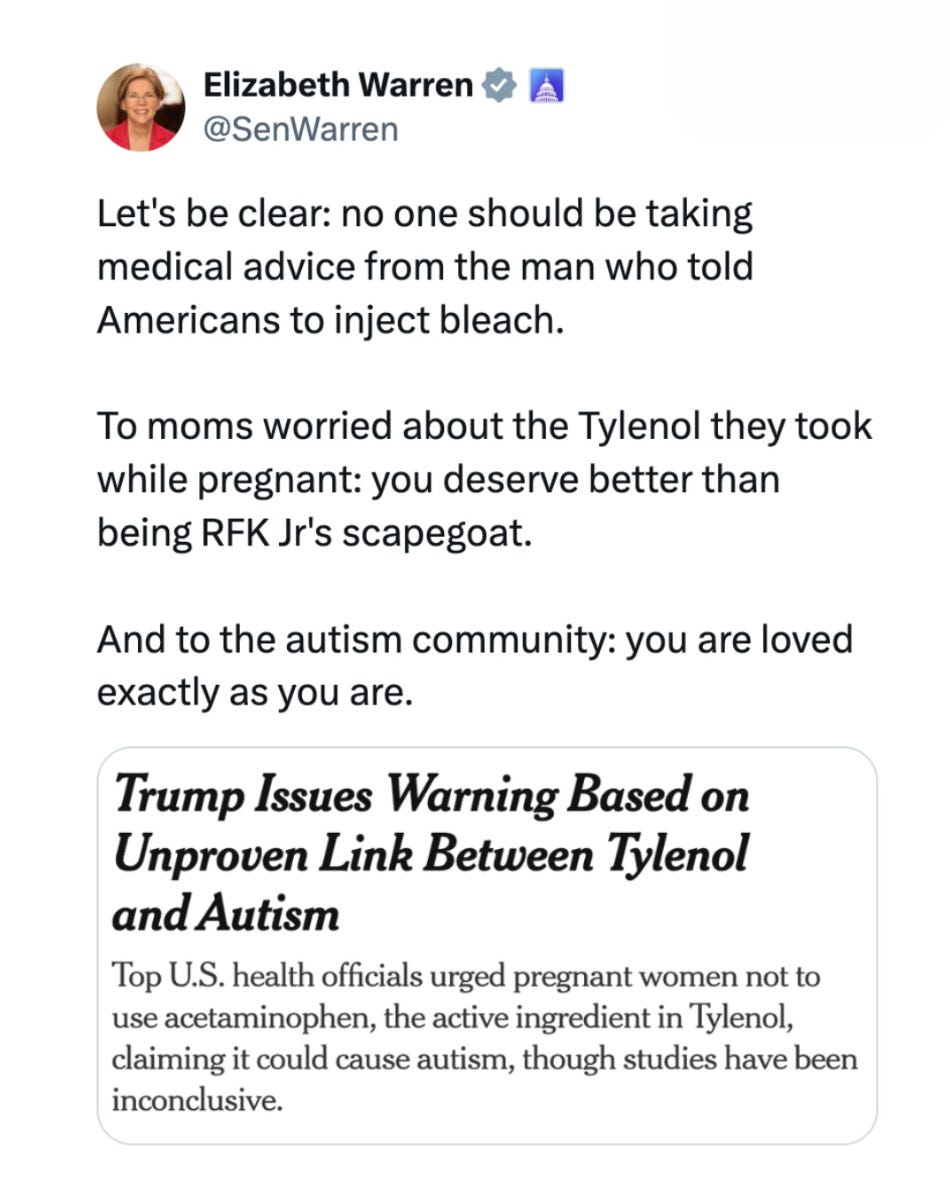
Senator Warren turned to cheap insults and certainties she can’t back up.
I also saw posts like this, which got 10’s of thousands of likes and comments:
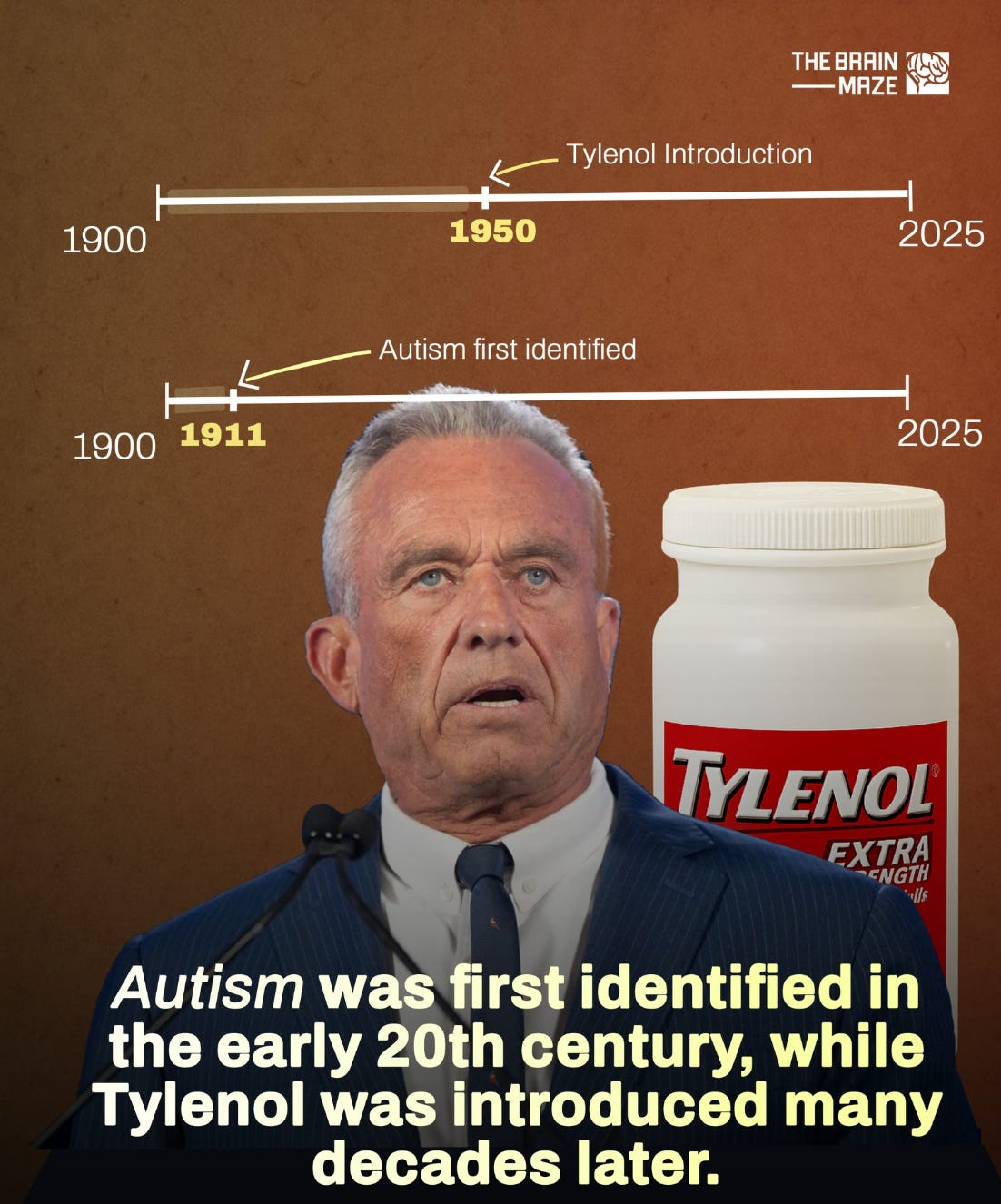
The creator of such a message doesn’t understand what is being proposed by the science being brought forth, yet the general public seems to think this is a good argument. Confusion ensues.
When we choose the route of insults and attacks, whether it be like what Warren said or whether it’s calling people Libtards, MAGAts, sheeple etc, we’re left with more of the same: a culture in swift decline, where we lose more and more respect for one another each day that goes by, and we don’t create a chared understanding. As stated before, a new approach is needed.
Mainstream media largely covered the topic, casting severe doubt on the subject, turning it political, and pretending that legal courts have somehow already proved that this is an outrageous claim. This is the same mainstream media that for decades told us that Glyphosate was generally safe because Monsanto’s science and government regulators bought by Monsanto said so.
So I began to look at the claim. Not the social media posts, not the simplified takes from either side, but the claim itself.
The claim from the NIH, FDA and HHS suggested that there may be a link between acetaminophen use during pregnancy and early life and autism in some cases. This was based on a re-review of prior research that was inconclusive.
Thus, the advice from U.S. public health is: if you don’t have to take Tylenol while pregnant, don’t take it. If someone had a really high fever and really needed it, that’s a different story. But if it’s not needed, avoid it until further notice.
Regardless of Trump’s rhetoric on the issue, it’s not an unreasonable position these public health organizations are taking. They are saying: we see some possible associations, we don’t know what’s going on, autism rates are rising fast, and therefore, if you don’t need it, don’t take it.
Before I mention some of the research, Kennedy has made it a goal to determine the cause of autism by September 2025. This is an unreasonable goal in my opinion, as it’s way too complex a subject to unpack in such a short time, but I also get that politics are at play here.
That said, I’m glad someone is looking at this because prior administrations have failed to properly address the issue and have avoided some of the most important considerations, which are total vaccine load, total toxic environmental load, and how these act in concert with one another to produce health issues, including neurodegenerative issues.
The truth is, there are likely many things contributing to the rise in autism rates, including the way it’s diagnosed and things like mass increases in chronic stress culturally.
The Science
There are several epidemiological studies that report associations between prenatal or early-life acetaminophen exposure and higher rates of autism spectrum disorder or ADHD. A Johns Hopkins analysis of umbilical cord blood found that babies with the highest acetaminophen exposure were about three times more likely to be later diagnosed with autism or ADHD.
Other large studies have found small increases in risk in some models. But the picture is inconsistent across studies and methods, and when stronger controls for confounding are used (for example, sibling comparison designs), many associations weaken; however, they are still there.
Simply put, the science suggests looking more closely at the link between Tylenol and Autism is a good idea. Is it contributing for sure? We don’t know, and it may depend on things like the amount it’s taken, the effect of other environmental toxins etc.
Of course, correlation does not confirm causation, but that is the basis of any scientific process; you ALWAYS begin with signals (correlation), and look more closely.
The Trump admin isn’t saying small doses of acetaminophen = autism. They aren’t saying anyone who takes acetaminophen during pregnancy will have autistic kids; they are simply saying: Does this increase risk? In order to understand, we have to look, and the signals are there to justify looking.
I wish we could just understand this as a culture, but it’s not that simple for many reasons, which I’ll get to later.
The biological pathway for acetaminophen to cause an issue is that it is metabolized in the liver and, at least in some situations, can use up glutathione as part of how it is broken down. That biochemical pathway is real and is why massive overdoses of acetaminophen deplete glutathione and cause liver damage.
Some researchers have hypothesized that even lower exposures in sensitive infants could affect antioxidant systems like glutathione and thereby influence neurodevelopment. A number of papers discuss this proposed mechanism.
So whether we’re talking umbilical cord exposure or something that’s outlined in the image below, those at the HHS think it’s worth taking a closer look. Further, why do we often not ask what makes some infants more ‘sensitive’ to things than others? Why is general sensitivity to health issues growing in the population? Instead, we tend to make general statements and treat everyone in batches - because it’s the most profitable thing to do.
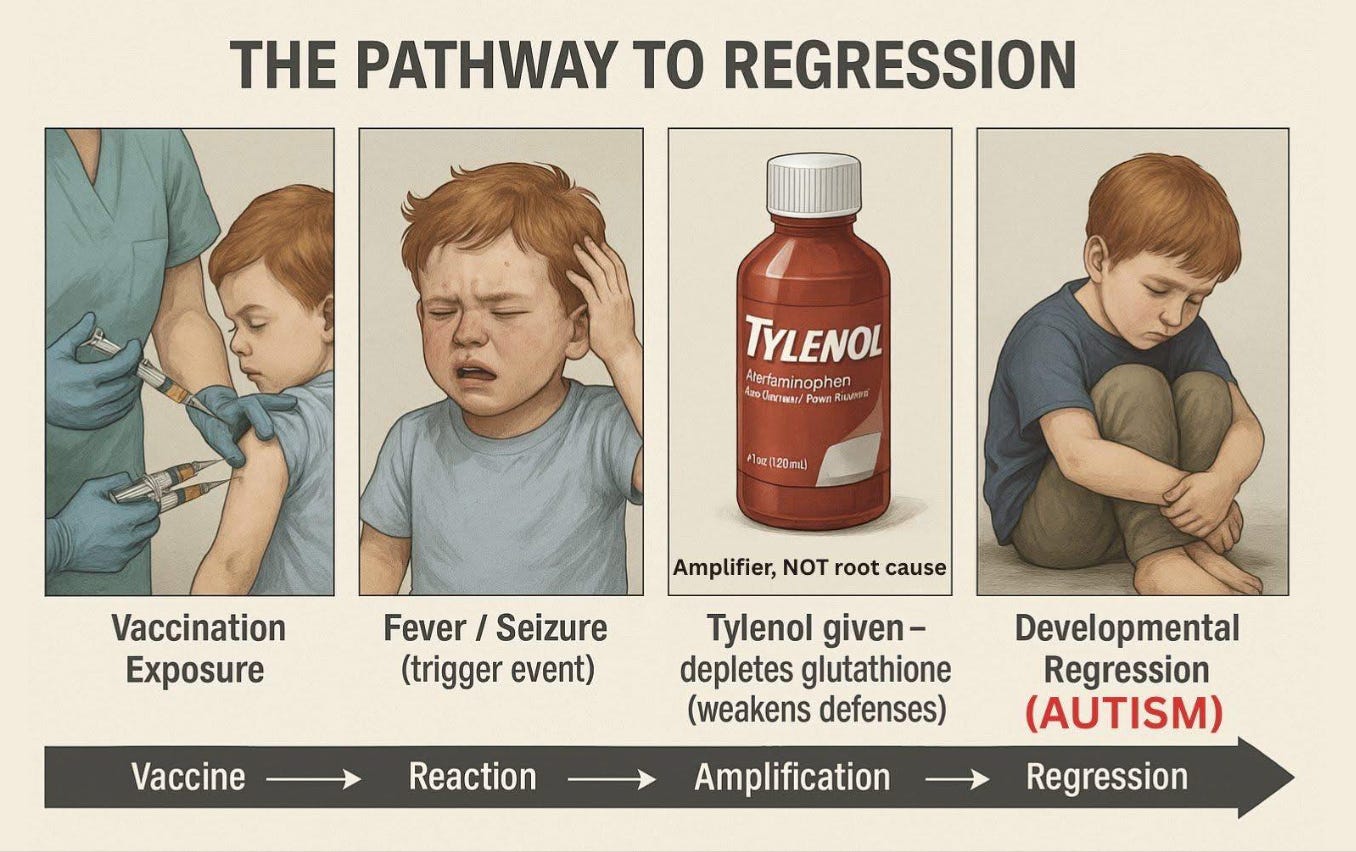
As seen in the image above, there is a specific claim that babies need glutathione to “process” vaccine adjuvants or that routine vaccines plus acetaminophen create an “overload” that raises autism risk. This is not really well understood yet. Why? It has never been studied well.
While the glutathione mechanism is biologically plausible in theory, the jump from plausibility to saying vaccines plus Tylenol cause autism is not backed by solid data yet, because it has not yet been studied in detail.
Tylenol themselves have said in 2017 on social media (which is also stated on their packaging), don’t use Tylenol when pregnant.
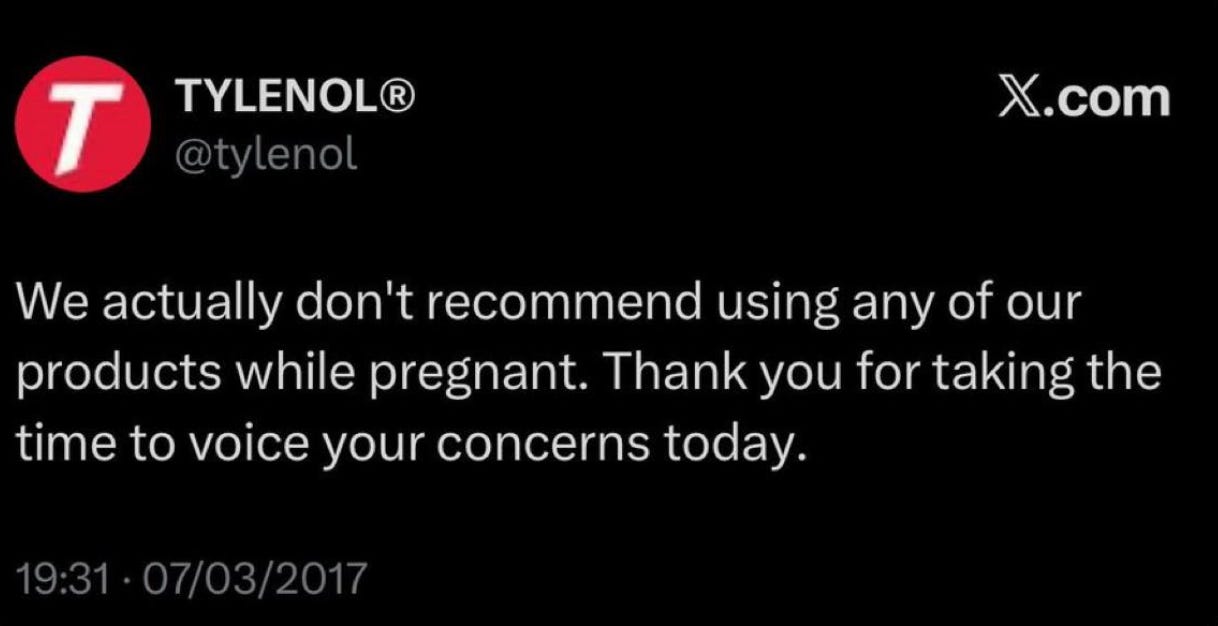
The bottom line here, the dramatic responses we’re seeing to this Tylenol issue are being birthed out of ignorance and political tribalism - not grounded logic and an open heart and mind. It’s reasonable to look more closely at this link.
Politics, Politics, Politics - And Some Change?
Political theatre likely plays a role in how this story unfolded as well. Sadly, it’s needed in our current culture, which is driven by a race to the bottom dynamic in order to win political debate. “My opponents will play nasty political theatre to enliven their base, so I have to as well or I lose.“ This is largely what we see in our modern political culture, even though the outcome is a more polarized and divided populace.
As mentioned, Kennedy wants to find an explanation for autism rates as quickly as possible. Further, Trump has made campaign promises around autism, and so action needs to be seen to keep the support of that part of his base. This, in part, might be why such a big spectacle is being made about the Tylenol subject - it gets everyone talking about it. Welcome to political theatre.
That said, the administration is building an “Autism Action Plan,” which includes linking acetaminophen to autism, promoting treatments like leucovorin, determining causes, and proposing new regulatory steps. This does show this admin is serious about leadership on a public-health concerns. I find Bhattacharya, Kennedy, and Makary to be refreshing bright spots in this admin, which is largely not something I align with.
This move also signals continued skepticism toward more mainstream medical recommendations that, to those in the health freedom movement, are largely influenced by Big Pharma and their biased science.
Further, by pushing for label updates for products like acetaminophen and warning of possible risks, the administration appears to be making pharmaceutical companies more cautious and the public more aware. This could potentially open up liability or regulatory pressure on Big Pharma as well.
But to be honest, we have to give this one more time to pan out, as Trump may protect Big Pharma interests more than a guy like Kennedy would want to see happen.
Back To The Spirit of Complexity & Questioning What We Thought We Knew
I stated in a social media post a while ago that RFK Jr and the new approach to public health in the US are being informed by a health freedom movement that fundamentally comes at public health from a different lens.
Instead of the reductionist and drug focused approach, it’s more functional and holistic. This means the public has to fundamentally get used to thinking about health in a way that isn’t so black and white, and isn’t the default. That in itself is hard for people to do.
What is driving health problems at their core? How can we get out of the mindset of “I got X illnes,s” and instead realize that someone doesn’t just “get” an illness, it comes from a breakdown in their body? How do we know the medications and food we’re consuming aren’t creating more downstream problems than they are solving?
How can we look at more complex answers? How can we do science that isn’t just about approving new drugs or protecting pharmaceutical interests (which is largely what happens now), but actually seeks to understand how to build solid health amongst the people?
This is more about holistic health, which is complex, yet this is not what people know. On this fact alone, culture will have a hard time with the work Kennedy is trying to do.
Further, a massive pharmaceutical industry stands to lose billions in revenue from a new way of looking at things. By nature of financial support, this will impact the propaganda we hear from politicians and some of the media in order to protect the old ways. Confusion, smear campaigns, doubt, and fear will be used to drown out any emerging signal.
This is why we often see people talking about RFK’s former heroin use and the “worm in his brain,” yet they cannot have a conversation about why they don’t agree with the ideas he has. Insults or cheap talking points are what we often see. Propaganda has done its job.
Bottom line: we’re talking about highly complex issues that few people understand are as complex as they are. This will take an openness and level of curiosity to understand that we just don’t see in much of media or on social media, which is often just looking to win a debate.
In order to attempt to tackle the complexity of issues like vaccines and autism, environmental toxins, total toxic load and holistic health, as well as solve the chronic health crisis, experts who are free to do real science have to spend time looking at and understanding them in ways often not conveyed to the public.
No one has debunked a link between vaccines, environmental toxins and autism. There is no evidence to support this claim, yet people think there is.
So, in the spirit of trying to solve a problem that is clearly caused by something, we have to start somewhere. It’s important to stop pretending we are certain about these issues, to stop buying into the division, and let science happen. No one has studied the effects of the US vaccine schedule on kids, no one, especially not in concert with total toxic load.
Beyond that, it has only been about 7 months for RFK Jr (a key driver behind all of this) to do much of anything with regard to cleaning up the public health and corruption problem in the United States. In our current system, real change takes a lot of time given the system’s rigidity. Before getting all caught up in the drama, I’m curious to see how things look in another year and a half.
Further, some in the alternative space fear Kennedy is not doing enough fast enough, and therefore “we’ve all been duped yet again.“ I don’t agree with this personally, as I feel the system design itself creates the need for us to meter our expectations as to what can be done and how fast.
The best part of what’s happening now is that a new conversation is happening. A conversation that back in 2009, when we started, was rare. By 2015, it was building, and now here in 2025, it’s mainstream. That’s worth celebrating, regardless of how pessimistic we feel we should be.
When we are largely in survival stress, change is hard and slow. This is because we are not in an ideal state to be flexible when we have a baseline of stress. Instead, we dig in and are rigid. I would argue that most of our culture feels this way, and this is before we even start talking about a poisoned information landscape making change even harder.
Finally, you’re not wrong or an idiot for having an open mind and waiting to see what unfolds. It seems less wise to jump to a conclusion either way at the moment. Yet it’s those folks who are pressuring others to see the truth they’ve prematurely jumped to.
Great article, Joe. To me, what is important is to ask questions, and go look deeper than media/social media posts. And to get beyond the person giving a message, to look at what is behind the message. To think for ourselves, dig for information, ponder, and be able to talk with others about things we may not agree with each other about. You have laid out a great foundation for all of that, in this article. I anticipate that the "Tylenol issue" is an initial doorway to what will be a LOT more that will be coming forward about health (and how we understand health), corporate and political interests that are not about health but are cloaked to look and sound as if they are, and so much more. THANKS for what you write, and how you write about it!
It is comforting to note that, in this world of misinformation, there is still a voice, like Pulse, that can provide a common-sense approach to pressing everyday issues.